
Allen County Court Record Requests
The Allen County Clerk of Courts holds the files for Common Pleas General Division, Domestic Relations, and Allen-origin Third District cases. Begin with Allen County eServices. Not every filed image can be viewed anonymously, though. For a docket sheet, judgment entry, order, or other existing paper the portal does not return, the counter and the public-record request process remain the dependable paths. Give the case number, court or division, parties, the document sought, and how you want it delivered. Oral requests are allowed. The Clerk does not require identity or intended use, and its policy aims to acknowledge or fulfill requests within three to five business days where possible. Treat that as a goal, not a guarantee. The office will not create a new record. Nor must it analyze material for a broad request.
- Identify the court and division from the case paper or docket.
- Describe the existing record, using the case number and document title or date when known.
- Choose inspection, pickup, mail, email, or a certified-copy request.
- Send the request to the correct clerk and prepay copying if staff requires it.
- Review any redaction notice or certification instruction supplied with the response.
Note: You may examine an original court file at the clerk's office. Common Pleas local rules do not allow the file to leave the building.
Allen County Clerk Request Choices
Ordering records from the Allen County Clerk comes with several delivery options. The public-record request form spells them all out. Email works through recordsrequest@allencountyohio.com, and fax is another route at 419-222-8427. You can also walk in to inspect or pick up the file. Mail is an option too. Whatever you prefer, the clerk will send copies that way. Want them mailed? Include a self-addressed stamped envelope with a check or money order. One catch: certified copies always go out by mail under the form. Plan for that delay when you place your court records request.
| Form field or choice | Type | Required | Allen County request note |
|---|---|---|---|
| Name of Requestor | Text | Optional | The form says a written request and identity are not mandatory. |
| Street Address | Text | Optional or needed for mail | Followed by city, state, and ZIP. |
| Phone Number | Text | Optional | May help the Clerk handle the request. |
| Today's Date | Date or text | Unspecified | Records the request date. |
| Describe what records you want to review | Long text | Practically necessary | Give as much specificity as possible. |
| Inspect records in building when ready | Checkbox | Choose a delivery preference | No inspection charge is stated on the form. |
| Copies: pickup, mail, or email | Checkbox | Choose a delivery preference | Plain-copy, mail, or email charges may apply. |
Check the form and the Clerk policy again before you order, since Allen County fee instructions can change.
Kinds of Court Records
An Allen County court record can mean several things. The docket, sometimes called entries and orders, is the chronological history of filings and court activity. A filed document sits behind each entry. That is the actual item, whether paper or electronic, such as a complaint, motion, order, or judgment entry. A certified copy is different again. The clerk issues it as an authenticated copy, and it is not the same as a web result, a weekly schedule, or an ordinary photocopy.
- Common Pleas and Domestic Relations dockets, pleadings, orders, and judgments held by the Allen County Clerk.
- Lima Municipal traffic, misdemeanor, civil, small-claims, and preliminary-felony records held by the Municipal Clerk.
- Probate estate, guardianship, marriage-related, and historic records held by the Probate Clerk.
- Juvenile division records, subject to the distinct confidentiality rules that can apply.
- Third District appeal records from Allen County matters held through the Clerk's appellate role.
Start with the paper in your hand. The court named on a citation, complaint, or case number tells you which office actually holds the record. A Lima Municipal weekly schedule can confirm a hearing date, but treat it as a convenience, not a certified court record. Got the case number? Turn to the Allen County Docket Search page. It sorts out how each court splits its public search channels for Allen County court records.
Allen County Probate Record Archives
Probate files in Allen County can reach back nearly two centuries. The Probate Clerk keeps originals on microfilm, microfiche, and computer. Estate records date from 1835. Marriages date from 1831. Guardian indexes and dockets start in 1970, and estate indexes and dockets in 1985. So an Allen County record missing from an online docket search may still sit in the archive on older media. For historic material, the counter or a written request matters most. The Probate records office lays out these date ranges and the division's public-record limits. Most records count as public. Adoptions and civil commitments are the exceptions, open only when the court grants access. When you write, name a date range and record category instead of asking whether a person is "in the system." The Probate archival-record source follows. Its coverage dates explain the lesson. Allen County historical research usually needs a clerk-assisted request rather than an online-only docket search.
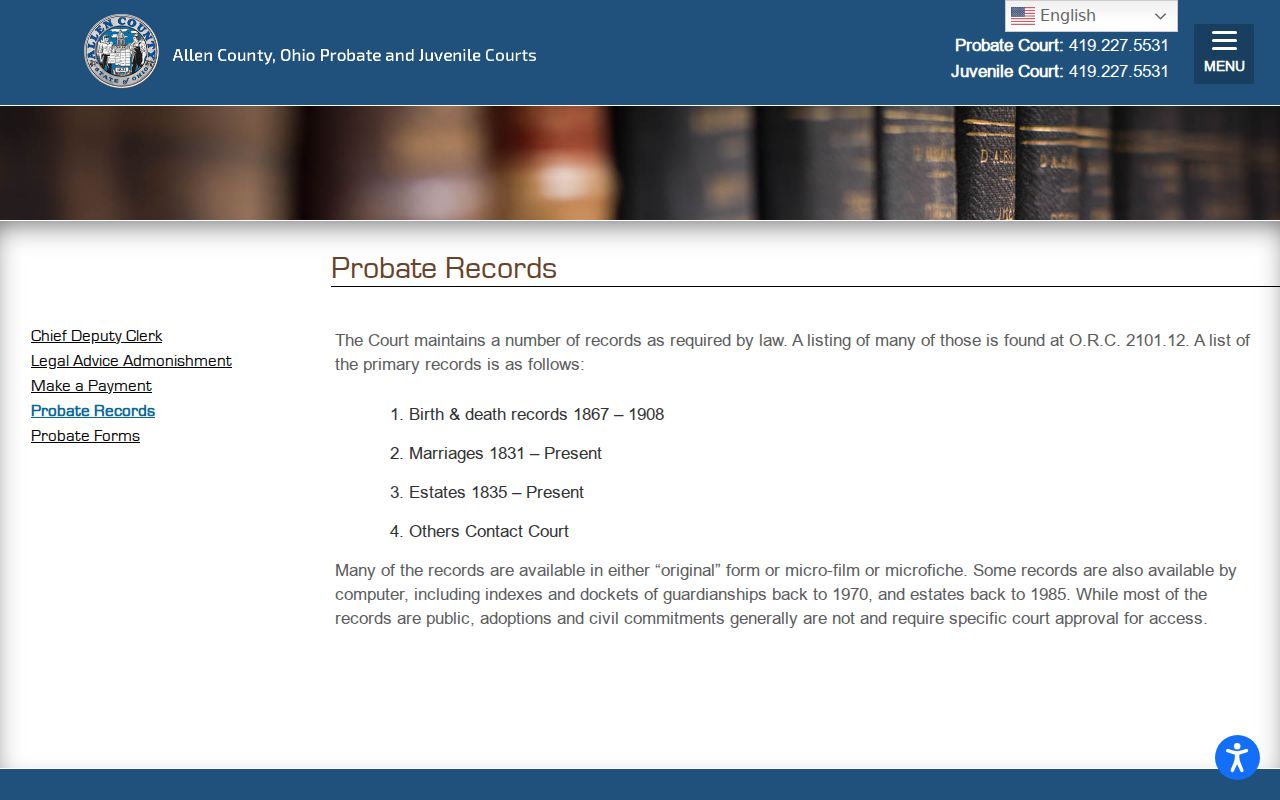
Older media reach past the dates in the court's computer indexes and dockets.
Court Records: What They Contain
What sits inside an Allen County court file depends on the court and the case type. The access rules matter too. The Common Pleas clerk files, dockets, indexes, and preserves civil, felony criminal, and domestic-relations pleadings. It then enters orders, decrees, judgments, and proceedings. Lima's clerk keeps the entries and orders for Municipal cases. That is a fair inventory of a typical filing. It is not a promise that any portal shows every document image or personal field.
| Case number | The identifier assigned by the court to locate one record. |
|---|---|
| Docket or entries | The chronological record of filings, notices, hearings, orders, and other case activity. |
| Pleadings and motions | Filed requests and responses, when public and available through the proper channel. |
| Orders and judgments | Formal court directives or decisions, commonly recorded as separate entries. |
| Calendar information | For a schedule, a date, time, courtroom, and hearing label rather than the full file. |
| Certification | A clerk authentication added to an existing record when a certified copy is requested. |
Transcripts live on a separate track. The rules of the Allen County Common Pleas Court treat the clerk's docket and its orders as one thing, and the spoken testimony a court reporter records as another. So a transcript is not simply a court document you can pull from a case file. It takes its own request. Ask the Clerk of Courts or the reporter which channel applies before you assume the testimony is downloadable.
Allen County Electronic Record Status
E-filing and public viewing are two different things in Allen County. Under the Common Pleas local rules, a pleading, motion, or order filed electronically becomes the official court record. That happens once the Clerk accepts it. The eServices route takes authorized filers through registration first. That registration can involve a confidential identifier and a payment-agent account. Acceptance for filing, though, does not mean anyone can download the document anonymously.
This is the heart of a common Allen County records problem. A docket entry may list an order by name. Meanwhile the filed image stays hidden from an anonymous visitor. So make a precise clerk request for the specific order, judgment, or docket sheet you need. State whether you want a plain copy or a certified copy. A transcript is not a court document either; ask for it by its own name.
Electronic does not always mean open-image access. Allen County eServices is the filing and gateway route, while the clerk remains the source for a record the public view does not provide.
Copy Fees and Certification
Copy charges in Allen County vary by office and format. The Clerk policy prices ordinary paper copies for the public at $0.05 per page. The request form tells a different story for certified copies. It sets $1 per page, with mailing required. Emailed copies carry a $2 transmission charge plus $1 per page on that same form. The policy and the form carry different dates. So confirm the current instruction with the Clerk before you order anything.
| Custodian and item | Charge | Record-request note |
|---|---|---|
| Allen County Clerk ordinary paper copy | $0.05 per page | Listed in the Clerk public-record policy. |
| Allen County Clerk certified copy | $1 per page | Request form says certified copies must be mailed. |
| Allen County Clerk emailed copy | $2 transmission plus $1 per page | Listed on the request form; confirm when ordering. |
| Lima Municipal ordinary copy | $0.25 per page | From the posted Municipal cost schedule. |
| Lima Municipal certified document | $2 per document | Certification is distinct from ordinary copies. |
| Lima Municipal download disc | $3 | Listed in the posted cost schedule. |
Allen County Clerk of Courts
301 N. Main St., Lima, OH
419-223-8525
Allen County Municipal Record Copies
Need a record from Lima Municipal Court? Go to the Municipal Clerk, not the Allen County Common Pleas Clerk. The two offices are separate. Under Rule 5.0, you can arrange to view public case records with the Clerk during business hours. You pay the fee the clerk sets for copies. You also review files at the office itself. Search and payment pages on the municipal side can track down a citation. But for an official docket or a certified document, the Municipal Clerk is the one who issues it.
For local copy and certification charges, check Lima's criminal and traffic cost schedule. A weekly courtroom schedule can help you spot an appearance date. It is not a docket sheet, though. It is no substitute for a judgment or a certified copy of a court record. Call the Municipal Clerk for the current fee. The staff can also explain the steps to get the exact record you need from Allen County municipal cases.
Access Rules for Court Records
Two layers of law govern access to Allen County court records. The state layer comes from the Ohio Rules of Superintendence 44 through 47. Other applicable law helps along the way. Ohio Revised Code 149.43, the Ohio Public Records Act, sits there too. It requires that records be prepared promptly for inspection. Copies must also arrive within a reasonable period, subject to lawful exceptions. The local layer is custody. The Allen County Clerk holds the docket. The Clerk applies its own rule that records are public unless exempt. When a redaction happens, the Clerk pairs it with the legal authority for it. Both layers control what a requester actually receives.
Key Ohio access authorities:
Ohio Sup.R. 44-47 defines court records and governs public, remote, and bulk access.
Ohio Revised Code 149.43 provides the state public-record inspection and copy framework.
Ohio Revised Code 2953.32 supplies case-specific rules for sealing or expungement of certain adult criminal records.
Several things can block public access to a court file. The list includes juvenile confidentiality, adoptions, civil commitments, protected personal identifiers, and sealing or expungement orders. When a record has protected fields, ask for a public redacted copy. The Clerk cannot hand over material that a court order or a statute keeps confidential.
Ohio's Public Records Act sets out that statutory framework. It opens the door to available records. The court and its clerk decide the channel for each specific record.
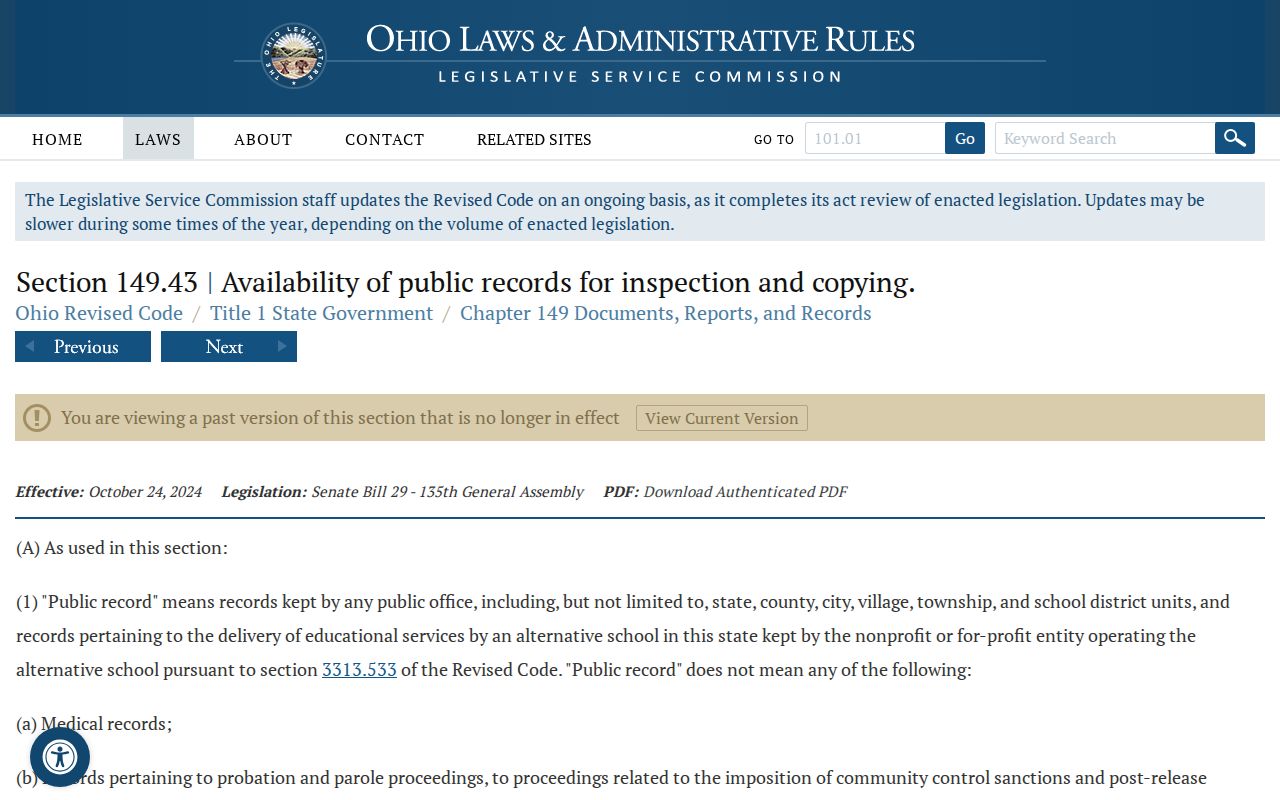
The statute does not expand access to confidential court material; it explains the public-record framework for records that are already available.
Allen County Federal Record Boundary
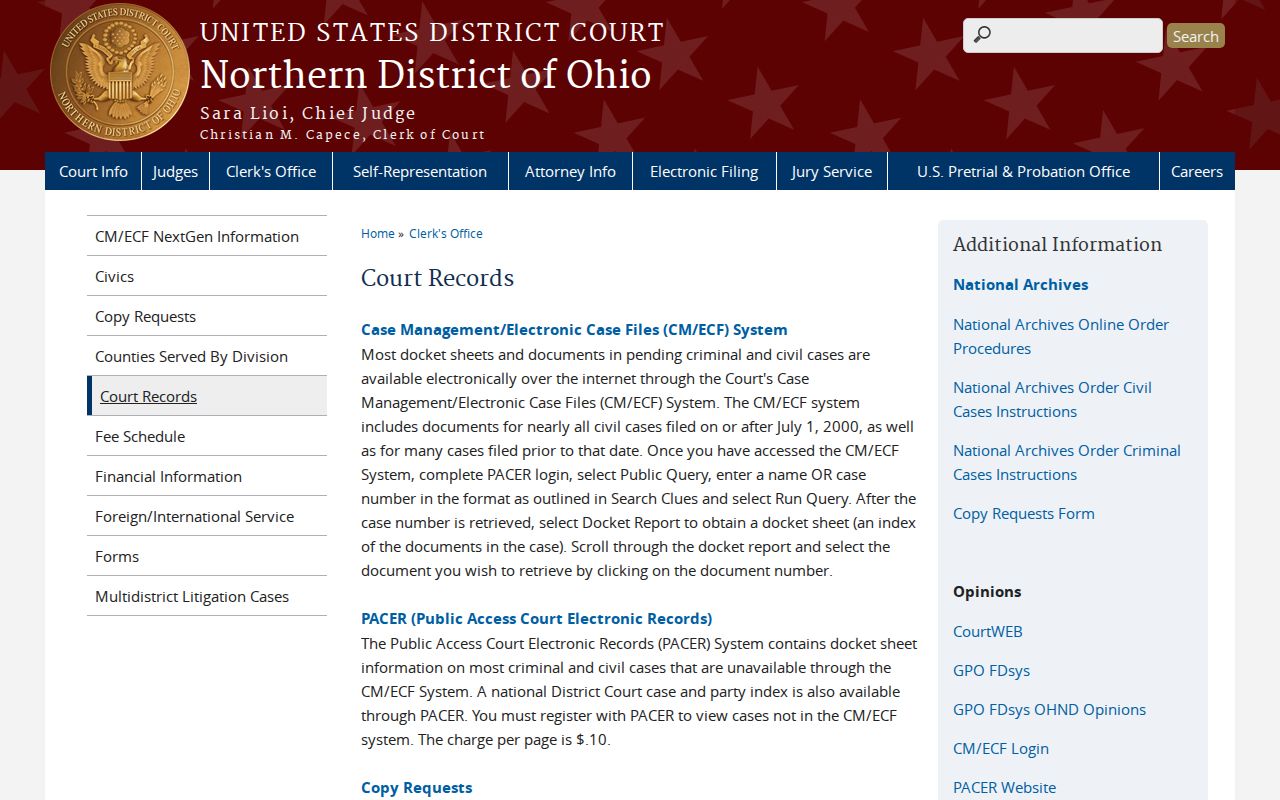
Federal cases live outside the Allen County Clerk's state-court system. Civil and criminal matters filed in the Northern District of Ohio run through PACER and CM/ECF. The federal clerk handles federal copies and certificates. The Northern District's official record page describes a separate system, with its own historical coverage and its own charges. Do not send a PACER request to the county clerk. A county docket portal will not return a federal case.
Northern District court-record instructions lay out that separate court system, the one that applies when an Allen County matter was filed in federal court.
PACER pricing sits apart from the Allen County and Lima Municipal copy schedules. PACER's official pricing page spells out those federal fees. It matters only for the federal record channel, never as a back door to a county court file.
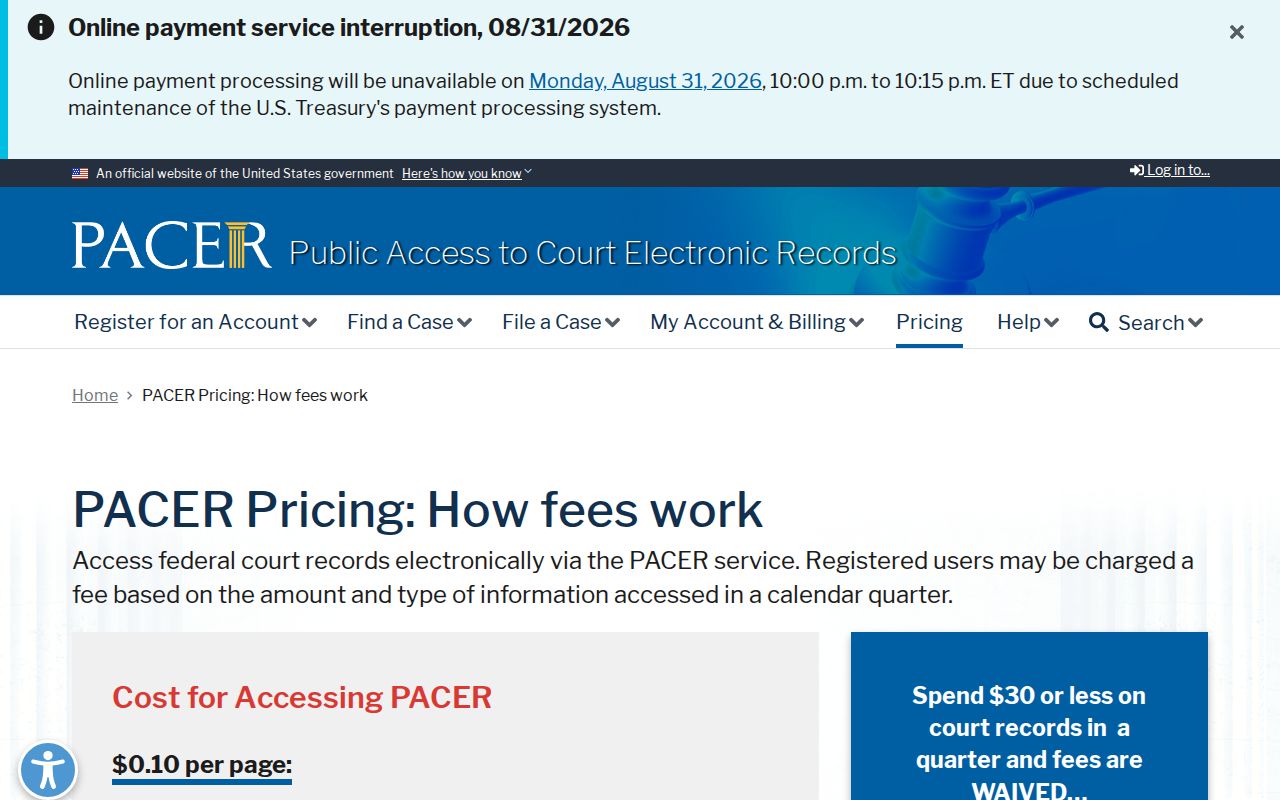
For a Common Pleas or Lima Municipal record, go back to the court and clerk that hold the Allen County file. That is where the docket lives.